I put a trap on my portfolio. Here is what walked in.
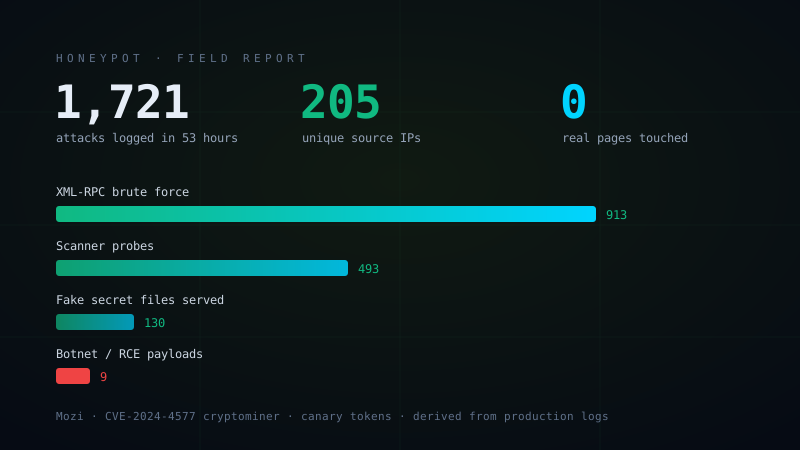
My portfolio is a small Flask site. There is nothing to steal on it and no login worth breaking. That is exactly why it is a good place to measure the internet's background radiation: the constant, automated, untargeted scanning that hits every public IP address whether or not anyone has ever heard of it. So I built a passive honeypot into the site and let it run. Over one 53-hour window it recorded 1,721 hostile requests from 205 unique IP addresses, and not one of them touched a real page.
Passive means passive. Nothing is blocked, no real route changes, and no visitor data is involved. The honeypot only answers requests that a normal person on a normal browser would never make.
How the trap works, without giving the trap away
The design is three layers, and I can describe the shape without publishing the map an attacker would need to route around it.
- Decoys. A set of endpoints that only scanners ever ask for - the usual furniture of a hacked CMS and some 'leaked' configuration and database files. A real visitor has no reason to request any of them. A scanner requests all of them.
- Canary credentials. The fake leaked files contain fake secrets. Each value is derived from the app's secret key with HMAC, so it is unique to this deployment and never appears in the source code. Nothing legitimate knows these strings, so if one is ever sent back to the site, the sender must have harvested it from a decoy. That single event is escalated to critical.
- Request-wide sensors. On every request, the URL and headers are checked (decoded twice, because scanners love to double-encode) for the signatures of Log4Shell, SQL injection, path traversal, file inclusion, command injection and cross-site scripting, plus known scanner user-agents and probes for file types this site does not even serve.
Every hit becomes one JSON line. A small report command turns the log into the numbers below.
The headline: it is almost all WordPress
This site has never run WordPress. It does not have a wp-admin, it has never had one, and it never will. It did not matter in the slightest. The single largest category of traffic - 913 of the 1,721 events - was attempts to abuse WordPress XML-RPC, and they came from just twelve IP addresses hammering the same decoy over and over. The payloads were password-guessing attempts dressed up as blog-posting calls, cycling through variations built from the domain name itself: the site's own hostname sliced into nikhil, nikhilsec, sec, and so on, as if a human somewhere assumed the admin password had to be some rearrangement of the brand.
The lesson for anyone running an actual WordPress site is blunt. XML-RPC brute force is not a targeted attack you need to provoke; it is ambient weather. If you run WordPress and have not disabled XML-RPC or put authentication in front of it, you are being probed like this right now, and your attacker pool is a dozen tireless bots, not one clever person.
The long tail: 239 paths that do not exist
The second-largest bucket was 493 scanner probes across 239 distinct paths that return nothing on this site: dozens of spellings of a leaked environment file (.env, .env.old, .env.bak, app/.env, and on and on), cloud credential files, exposed version-control directories, and PHP info pages. This is content discovery - a scanner trying hundreds of filenames in the hope that one careless deploy left a secret in the web root. It is cheap to run and it only has to win once. The defensive reading is that your attack surface is not the pages you published; it is every path a scanner can imagine, and a single leaked config file turns months of quiet probing into an instant compromise.
The interesting nine: real exploitation attempts
Under all the noise were a handful of genuine exploitation payloads, and they are the part worth reading closely.
- Mozi botnet, twice. Classic command injection aimed at home routers and IoT gear - a request that tries to make the device download and run a binary called
Mozifrom the attacker's server. Mozi targets the appliances people never patch. It was aiming at a router firmware endpoint that, again, this site does not have. - CVE-2024-4577, aiming for a cryptominer. The most sophisticated thing in the window was a PHP-CGI argument-injection attempt (the 2024 'BatBadBut'-adjacent Windows PHP flaw). The body carried a base64-encoded shell script that, decoded, writes out an SSH private key, uses it to
scpa second-stage payload from a remote host, and falls back towget/curlpiping to a shell if that fails - the standard shape of a commodity cryptomining dropper. - Two credential submissions. Someone, or something, actually typed into a fake admin login. The username was
heyyand the password was unprintable in a family write-up. Even the laziest attack in the set was automated enough to not notice the form was fake.
What the shape of the data actually tells you
Three things stand out once the numbers settle.
Targeting is a myth at this layer. Not one request was specific to me, my stack or my content. Everything assumed WordPress, PHP, a router, or a leaked file - the four most common things on the internet. You are not attacked because you are interesting; you are attacked because you have an IP address.
A dozen hosts make most of the noise. The top ten source IPs accounted for 1,194 of the 1,721 events, while 155 of the 205 addresses showed up exactly once. That bimodal shape - a few relentless brute-forcers and a long tail of drive-by scanners - is the signature of commodity botnet traffic, and it is why rate-limiting and simple reputation blocking buy you so much.
No canary came back. The most valuable number is a zero. Across the window, not one of the harvested fake credentials was ever replayed against the site. The scanners grabbed the decoy secrets and never used them - which is itself a finding: this traffic is mass collection, not hands-on-keyboard follow-through. The day that zero becomes a one is the day the character of the attack changes, and the honeypot would tell me the moment it happened.
Why a honeypot belongs on a normal site
You do not need a lab or a cloud bill to see real attacker behaviour. You need one public IP and the willingness to log what hits it. The build cost me a blueprint of decoys, some HMAC-derived canaries, a handful of regular expressions and 23 tests, and it turned a quiet portfolio into a sensor that reports exactly who is knocking and what they are trying. If you run anything on the public internet, instrument it. The background radiation is already arriving; you may as well read it.